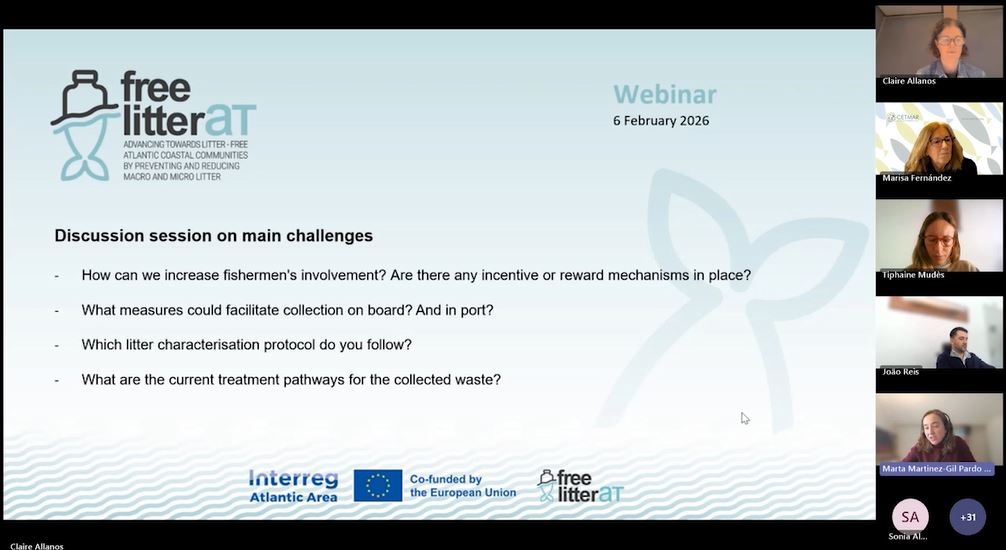
On 6 February 2026, the webinar “Fishing for Litter in the frame of PRF directive: experiences and challenges in the Atlantic” was held within the framework of the Free LitterAT project. The event aimed to review the state of implementation of Directive (EU) 2019/883 on port reception facilities for the delivery of waste from ships (PRF Directive) and to share practical experiences related to Fishing for Litter initiatives across the Atlantic area. Around 60 participants attended this webinar.
The webinar, chaired by UBS, brought together representatives from European institutions and networks, public administrations, port authorities, international organisations, and technical entities, who discussed recent progress and key challenges associated with the management of marine litter passively retrieved by the fishing sector, as well as its integration into port waste management systems.
The event opened with a presentation on the European regulatory framework, focusing on the PRF Directive, its current level of implementation, and its links to monitoring and reporting obligations for passively fished waste. This was followed by a brief overview of actions under the OSPAR Convention, highlighting progress in the Northeast Atlantic, the alignment with the OSPAR 2030 Strategy – particularly Strategic Objective 4 on reducing marine litter – and the importance of adequate funding for the long-term sustainability of these initiatives. Afterwards, CETMAR presented the initial results and findings of the Free LitterAT project, highlighting the current situation in the participating countries concerning PRF implementation and Fishing for Litter schemes, the main lessons learned during a compilation and consultation exercise and the resources that are being generated: guidelines for the implementation of SUP and PRF requirements; an inventory of good practices for waste management; guidelines and a training package for implementing the management of passively fished waste in line with PRF and a dedicated website showcasing good practices.
KIMO shared its long-standing work on marine litter, highlighting the Fishing for Litter initiative launched in the Netherlands in 2004 and now active in 11 European countries. Recognised as a best practice by the European Commission, HELCOM, and OSPAR, KIMO coordinates projects in the UK, Netherlands, and Belgium, working closely with fishermen to collect litter, provide guidance and educational resources, and promote recycling, including pilots such as the 2025 Isle of Skye Fisheries Recycling Coalition.
A central part of the webinar was dedicated to the presentation of national Fishing for Litter experiences in Portugal, Spain, Ireland, and France where representatives of public bodies, managing entities or initiatives such as DOCAPESCA, MITERD, MTU and Repêchons les Oceans shared approaches, operational models, and practical solutions to facilitate the collection, characterisation, and proper management of marine litter landed in ports as well as tools and key resources generated. This was the case for the general criteria for the implementation of Fishing for Litter schemes, developed in Spain by MITERD in the frame of Intemares project. Particular emphasis was placed on the importance of improving training and awareness, communication flow and coordination between all the actors: fishermen, port authorities, waste managers, and competent administrations.
The final part of the webinar focused on the main challenges in implementing management systems for passively fished waste, examining the perspectives of ports and the challenges associated to the waste management and valorisation. For these matters, the webinar counted with the Port of Vigo and the Technological Centre AIMPLAS. Key aspects discussed included the need for adequate infrastructure, clear procedures, reliable traceability systems, and mechanisms to ensure the operational and economic viability of these initiatives, in line with circular economy objectives and marine environmental protection goals.
The webinar concluded with an open discussion session, during which common challenges and opportunities for improvement were identified, reaffirming the role of projects such as Free LitterAT as key platforms for knowledge exchange, the harmonisation of practices, and support for the effective implementation of the PRF Directive in the Atlantic region.
This webinar will be followed by local workshops in Spain, France, Ireland and Portugal to discuss issues related to the management of end-of-life fishing gear and passively fished waste.